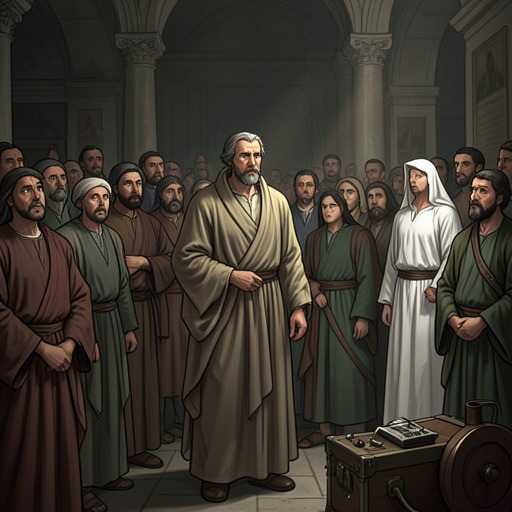
Baal
The Satanic VersesBaal is the sharp-tongued poet whose verses expose the shifting balance between art and power in Jahilia. Abu Simbel first makes him an instrument of political opposition to Mahound; years later, Baal turns poetry and impersonation into a challenge to the victorious order. His career links public satire to private compromise, and his final defiance makes the writer himself part of the argument over who may speak and who may be forgiven.
Identity and Public Voice
Baal enters the story as a young poet already feared throughout Jahilia for his satire. He moves through a city where poets perform for pilgrims, reciting forms that range from rajaz, whose rhythm is associated with a camel’s walk, to qasidahs about love, desert journeys, and hunting. The annual poetry competition gives verse public standing: the seven winning poems are to be displayed on the House of the Black Stone. Elsewhere, rival chiefs and tribes pay poets to compose attacks on one another, and Baal’s reputation rests on his ability to make those attacks cut.
His own account of a poet’s work reaches beyond clever insult. He presents poetry as a way to name what cannot be named, expose fraud, take sides, provoke argument, and keep the world from settling into complacency. The image of words drawing blood is not incidental: in Jahilia, verbal attack belongs to a culture that also celebrates vengeance in verse. Poets write songs for avengers after a blood feud is settled, and Baal is regarded as especially gifted at that work. His public voice can therefore serve power as readily as challenge it, a tension that shapes his dealings with Abu Simbel and Mahound.
Abu Simbel’s Commission
Abu Simbel approaches Baal in the crowded streets and brings him toward the House of the Black Stone under the guise of a private conversation. He asks the poet to undertake a literary commission, acknowledging that the arts of metrical slander are beyond his own abilities. Baal objects that an artist should not become a servant of the state. Abu Simbel answers by pointing out that Baal has already written assassination songs; Baal distinguishes that work as a cultural matter, but the exchange exposes the limits of his claim to independence.
At the shrines of Uzza, Manat, and Al-Lat, Baal initially mistakes Abu Simbel’s appeal to a shared goddess for an appeal to religious fellowship. He is devoted to Al-Lat, whose temple is controlled by Abu Simbel’s household through Hind, and thinks his own devotion explains the Grandee’s overture. Abu Simbel instead reveals that he means Hind, his wife, with whom Baal has been having an affair. He then orders Baal to write against Mahound and identifies the targets: Khalid, Salman the Persian, and Bilal, gathered by the graves of Ismail and Hagar. Baal protests that Mahound’s small following cannot defeat Jahilia’s many gods and mocks the idea that a revolution led by water-carriers, immigrants, and slaves could prevail. Abu Simbel insists that the verses must be masterpieces and makes clear that Baal has no choice.
Baal’s work becomes part of the atmosphere Mahound describes when speaking with Salman the Persian. Mahound observes that his audiences are small—never more than fifty, with half made up of tourists—and that Baal’s lampoons are displayed around the city. The satire has not made the movement powerful, but it has helped define how the city sees it. When Mahound and his followers leave Jahilia for Yathrib, Baal composes a valedictory ode that asks what kind of idea Submission now appears to be. The question survives the circumstances of its composition and returns to Baal much later, when the movement has become dominant.
Exile, Return, and Reassessment
After a quarter-century, Baal recognizes that Mahound is returning when he sees a blood-coloured tear at the left eye of Al-Lat’s statue. The aging poet contrasts the returning Mahound’s power with the circumstances of his departure. Jahilia, too, has changed: once shifting like a mirage, it has hardened into a poorer, more ordinary city, while Mahound’s power has cut off its pilgrims and caravans. The fairs that once supported its importance have dwindled.
Baal has lost his place in public life. He writes poems of unrequited love rather than political satire, and the old market for insults has disappeared under the fear surrounding Mahound. The decline of the cult of the dead has also reduced demand for epitaphs and revenge odes. Now fifty, Baal is physically diminished and increasingly isolated; impaired sight and hearing make the world less distinct, while his poems fill with losses of youth, health, love, money, and certainty. When Salman the Persian finds him, Baal initially fears being drawn into trouble. He remembers that Abu Simbel threatened and bullied him into writing the old satires, and insists inwardly that he can no longer be mistaken for the young poet who once frightened anyone.
The return of Mahound forces Baal to reconsider the question in his old ode. The first test of a new idea is whether it will compromise to survive; the next comes when it wins and its enemies are at its mercy. Baal recognizes that everyone has changed, except Hind, and wonders what Mahound will do with power. His reflections are not simply a restoration of his former political confidence. The old satire has failed to preserve Jahilia’s former order, and his own artistic life has collapsed with it; the question now concerns the conduct of victory rather than the prospects of a weak movement.
Al-Lat, The Curtain, and a New Form of Resistance
The destruction of Al-Lat’s great temple at Taif brings Baal to a further change. His grief is genuine: devotion to the goddess may have been his one sincere attachment. Yet her destruction also reveals to him the emptiness of having loved a stone that could not defend itself. He concludes that Al-Lat is dead and had never lived, but that this conclusion does not establish Mahound as a prophet. Baal arrives at godlessness, begins to move beyond belief in gods, leaders, and rules, and understands that his story and Mahound’s have become entangled in a conflict that must reach a resolution.
Baal takes refuge at The Curtain, where the performers have affection for him and where his assumed position as a eunuch who is not one gives him a place among them. When the women begin taking on the identities of Mahound’s wives, the brothel turns political impersonation into a shared performance. The business increases by three hundred per cent. Customers wear masks, and their circulation around the central Fountain of Love recalls the pilgrims’ movement around the Black Stone. Baal sees the arrangement as one way to refuse Submission without openly confronting its authorities.
As the performances continue, the women’s adopted identities begin to displace their former ones. They eventually decide that they would rather be Baal’s brides than remain married to the fountain in the courtyard. He agrees to the marriages, and they organize a rota for his time with each of them. They also ask him to behave more like the husband they are impersonating, while Baal refuses to change his own name. The role alters him nevertheless: he begins to order the women about, settle their quarrels, and punish them when angry. He falls in love with one of them, and the life he had entered as a refuge becomes a private, profane mirror of Mahound’s household. He begins writing again.
The new poems are love poems, each dedicated to one of the twelve women. Baal describes his writing as an experience in which he seems to see himself standing beside himself, speaking verses that he then records. The women treat these pauses as part of the creative process and protect them. Their household and Baal’s renewed work thus depend on performance, but neither is merely a disguise: the roles produce attachments and a new poetic voice even as they reproduce the structure they mock.
Trial and Final Defiance
Baal brings the poems to the jail and, over twelve evenings, recites a new one each time and nails it to the wall. Their beauty silences the other versifiers and draws the women to the windows. The audience initially responds to the poems without recognizing their full provocation. On the twelfth evening, when the names of Baal’s twelve wives are recognized as those of another group of twelve, admiration turns to outrage. Baal removes his turban, identifies himself, and declares that his jurisdiction is that of his Muse—or, as his performance makes clear, his twelve Muses. Guards seize him.
Khalid wants Baal executed immediately, but Mahound orders that he be tried after the women. The twelve are sentenced to death by stoning, and Baal then stands before Mahound. Asked to explain himself, he recounts his time at The Curtain plainly, including his earlier cowardice and his claim that his later actions were an attempt to make amends. The crowd, despite its determination not to laugh, breaks into laughter as the story unfolds. Mahound recalls that the same people once enjoyed Baal’s mockery of the Recitation and now see him dishonouring the Prophet’s household. Baal says he has finished and leaves the decision to Mahound.
Baal is sentenced to be beheaded within the hour and is led away toward the killing ground. His final exchange with Mahound names the shared vulnerability of writers and prostitutes: both have crossed the boundaries of the order that condemns them. Mahound answers by treating the two groups as indistinguishable. The narrative ends Baal’s arc with that sentence, not with a depicted execution. He has moved from a poet coerced into serving a ruler’s politics to one who openly claims the authority of his art, even when that claim cannot save him.